Gethsemane comes from the Hebrew words 'gath' meaning press, and 'shemen' meaning oil. The fact that Christ chose a garden called Gethsemane is significant for many reasons. Olive oil was considered one of the most important substances for life. This rich golden oil was used to light the home of every family in Judea. Oil was also used to light the inner chamber of the Temple in Jerusalem. It was used to cook most food and in particular was used in the process of making bread, the very staff of life. Olive oil was also used to help create many ointments that were used for both the living, for healing purposes, and for the dead, to anoint the body prior to placing it in the tomb. Oil was also used to anoint kings, priests, and prophets. In short, olive oil played a central part of Jewish religious and daily life.
 |
| Iron age courtyard with olive press (from Atlas of the Bible, page 80) |
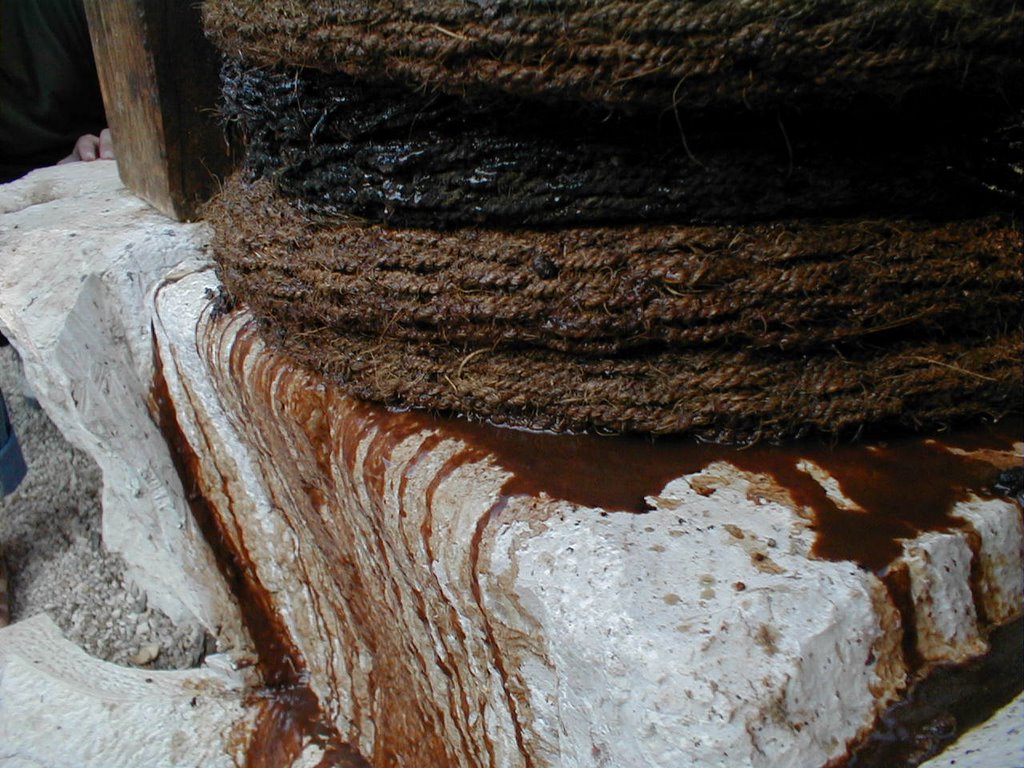 |
| Note how the olive oil is reddish-brown in color (from Satterfield) |
Christ alone paid the price for sin. He had the weight of the world press down upon Him, crushing Him until He bled from every pore. How grateful I am that on this night the Christ would be willing to bear the burden of my sins, that I might be healed.
In 2007 I had the chance to sit in the Garden of Gethsemane in Jerusalem. As I sat there in the Church of All Nations (the Catholic Church located in the garden), I felt a great pain for the suffering that Christ suffered on my behalf. I sat there completely alone in the church and thought of when He was completely alone in the garden. I sat there in dark (the chapel is intentionally dark to represent night) as I thought of how the Messiah knelt in darkness, pleading on my behalf to the Father. As He bore my burden, blood came from every pore. As these thoughts filled my mind, I was then filled with the most joyous happiness I have perhaps ever felt. I did not feel guilt for His pain, I felt peace. I did not feel anxiety for the suffering I caused Him, I felt forgiveness. I did not feel sadness for causing such anguish, I felt pure love.
I love my Savior, and will be eternally grateful for that which He did for me, in a garden called Gethsemane. In a garden that by its very name symbolizes the freedom, life, and light that has been brought into my life through His precious blood.
[1] Gethsemane, by Bruce Satterfield of BYU-Idaho
[2] For pictures showing entire process of making olive oil see Gethsemane, by Bruce Satterfield
[3] See Mashiach (Hebrew) and Christos (Greek) in Strong's Concordance

Thank you. The symbolism makes His sacrifice all the more poignant.
ReplyDeleteGlad you enjoyed it!
DeleteThank you for sharing your experience in The Garden of Gethsemane, while you were inside the Church of All Nations. You had a very special spiritual experience. I love your "Redeemer of Israel site and your videos. I sincerely appreciate your construction and presentation of this most significant doctrine, the life and teachings of Jesus Christ. Thank you, Daniel.
DeleteMr. Haymore, thank you for the kind words! I always appreciate to know how people enjoy the videos and website! And yes, it is an experience I will always remember.
DeleteWow thank you for this article i now see jesus in a whole new way..God bless
ReplyDelete